How Can I Tell What Transmission Is in a F150
Whether you drive a 500-hp sports car or a 96-hp economic system hatchback, all that dominance under your car'south or truck's hood is useless if the engine's torque doesn't go to the drivewheels through a complex maze of gears.
In fact, the drivetrain may be the least understood part of a vehicle. New innovations in iv-wheel and all-wheel drive have only fabricated that confusion worse for many drivers. Here'south a primer to help explain that mystery under the floorboards: what really happens when y'all press downwards on the accelerator.
FRONT-WHEEL DRIVE
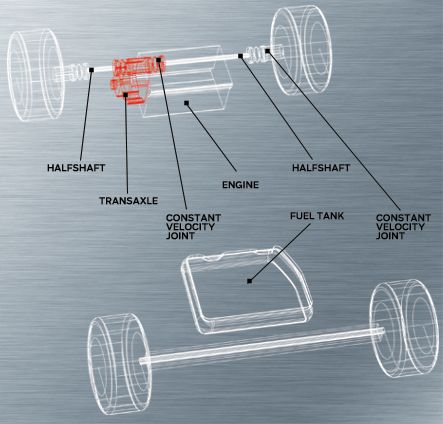
Though front end bulldoze can be constitute in such classics every bit the 1929 Cord, the overwhelmingly popular modernistic configuration is based on the 1959 Mini. Its creator, Sir Alec Issigonis, put the minor engine transversely--sideways--under the hood, mounted the transmission and differential in one unit called a transaxle, and installed that underneath and to the rear of the engine. While some forepart-drivers have a longitudinally--front end-to-rear--mounted drivetrain, all the components are withal up front end. Because the front wheels must steer every bit well as propel, they are connected to the beam halfshafts via complex universal joints, called abiding velocity joints, which tin transmit power smoothly while severely articulated.
PRO
• More room for people and cargo.
• Better fuel economy due to reduced weight.
• Improved wet-atmospheric condition traction thanks to the weight over the drivewheels.
CON
• Increased wearable on front tires and intermission.
• Cramped engine compartment makes service hard.
• Limits to amount of power the front wheels can handle without making steering unpredictable.
• Reduced moisture-conditions traction on upgrades.
Transaxle
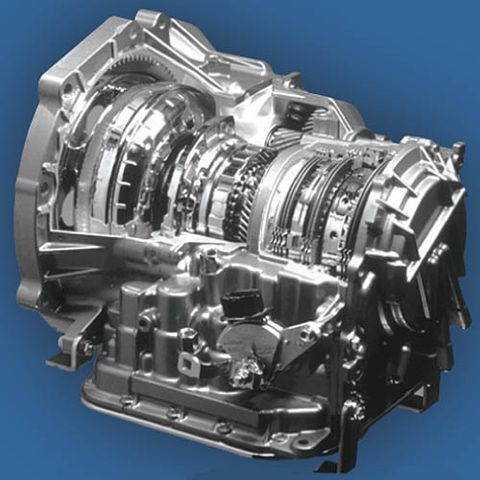
The functioning of any transaxle is exactly the aforementioned every bit that of any manual. The divergence is this: Instead of existence connected via a long driveshaft to the rear axle, the transmission's output shaft drives a large gear that meshes straight with the differential'south ring gear. And the differential itself (which would be mounted on the rear axle in a rwd car) is located in the transaxle housing, mounted parallel to the transmission. As power is applied, the differential distributes information technology to the two forepart wheels via halfshafts.
Continuously Variable Transmission (CVT)
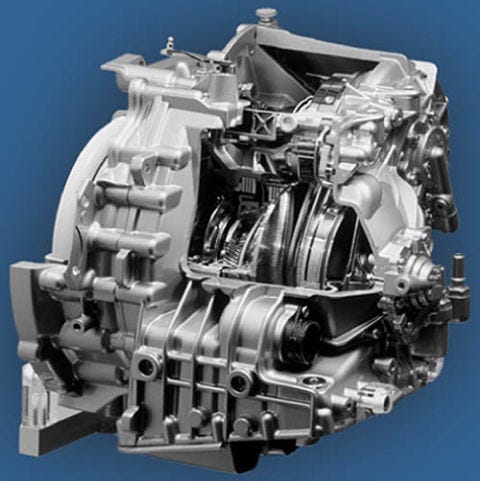
CVTs are gaining popularity and are used in several new Fords, Saturns and Audis. Instead of gears, the CVT uses a belt betwixt 2 pulleys. 1 is driven past a shaft from the engine, the other drives a shaft to the differential unit and drive axles. Both pulleys are split so that their halves can slide closer together and further apart. As the belt rides higher and lower in the pulleys, the effective gear ratios between the driving and driven shafts change.
REAR-Bicycle Bulldoze
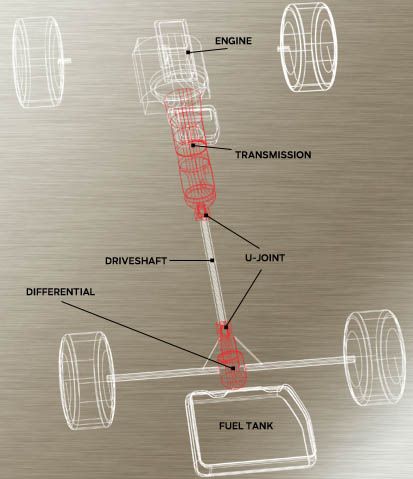
However the archetype, rear drive was basically the only drivetrain organisation for many years. A longitudinally mounted engine, with the transmission bolted straight to information technology, sends power via a driveshaft to a differential unit at the rear axle. The differential turns the power xc° and sends it to the rear wheels. (Some sports cars such as Corvettes, Ferraris and Porsches identify a combined transmission and differential--or transaxle--in the rear.)
The driveshaft connects via yoke-type universal joints and a splined expansion joint to allow for vertical and longitudinal suspension move.
PRO
• Better front/rear weight distribution results in nimbler handling.
• Ease of service thanks to spread-out components.
• Less wear and tear because the front tires don't take to both steer and pull the car.
CON
• Poor wet-road traction and stability without sophisticated electronic controls.
• Reduced passenger and cargo room.
Manual Transmission
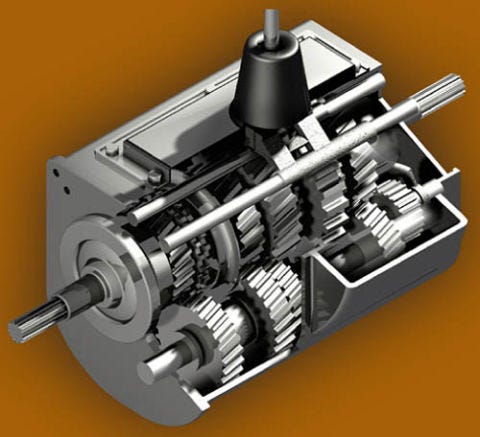
The gearbox is mated to the engine via a spring-loaded clutch plate faced on both sides with friction material. The clutch must be disengaged to shift gears, and the manual must exist in Neutral, or the clutch disengaged, for the vehicle to be stopped while the engine is running. The transmission consists of an input shaft from the engine and an output shaft to the drivewheels. The input gears tin slide back and forth to mesh with their output mates. Synchronizer cones between the sliding gears and shaft permit smooth shifting. Reverse gear is on its ain shaft.
Automatic Transmission
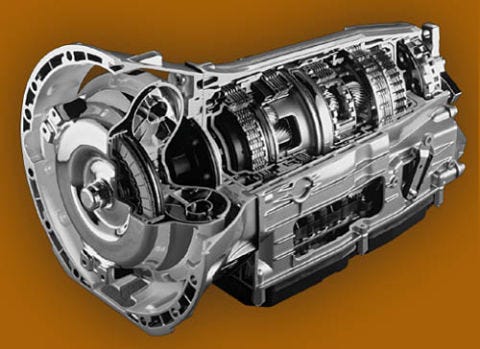
An oil-filled torque converter that multiplies engine torque inside the transmission bellhousing allows some slippage so the vehicle can be stopped while the engine runs. A friction clutch built into the middle of the converter locks its input and output shafts to the aforementioned speed for highway cruising. Computer-controlled hydraulic pressure selects which combination of gears within several planetary sets can rotate, changing the ratios betwixt the input and output shafts.
Open Differential
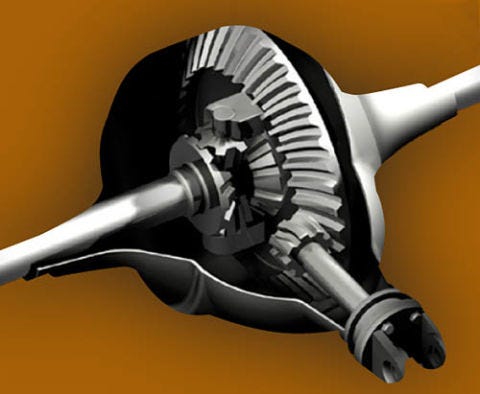
While cornering, the outside wheels cut a wider arc than the within. The differential needs to ensure that the outside and inside wheels are allowed to plow at different speeds—hence the name—while still supplying power to both wheels. The basic differential housing contains a big ring gear that meshes with a small pinion gear driven by the driveshaft. The ration between the ring and pinion gear is known as the last-drive ratio or rear-axle ratio. The ring gear besides spins a carrier containing perpendicularly meshing spider gears that allow the left and correct beam shafts to spin independently. Downside: The cycle with the least traction limits ability applied to the road.
Express-Slip Differential
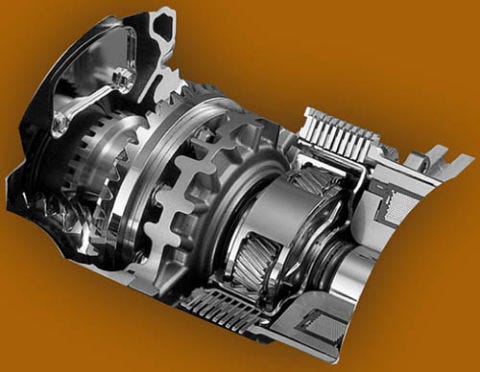
The concept of providing traction to the nonslipping drivewheel with a limited-sideslip differential dates back at least to the tardily 1950s. Though there are now many wrinkles to the old theme, the essentials are the aforementioned. The spider gears are mechanically linked to share torque regardless of conditions. This can exist done simply past calculation spring-loaded clutch packs that keep the spider gears from spinning. Power then flows to both wheels to the limit of the clutch packs' capacity. The spiders can also be pneumatically or electrically locked together—simply this defeats the differential role.
Iv- & ALL-WHEEL DRIVE
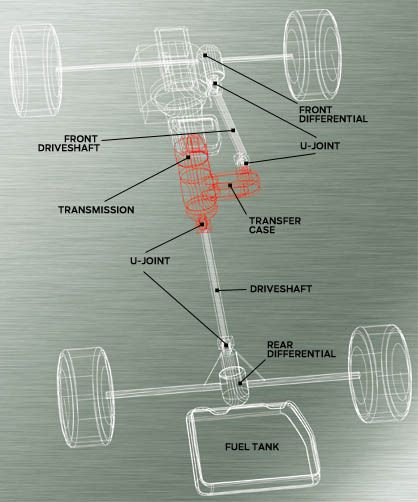
From a traction betoken of view, the best of all worlds is when both front and rear wheels are propelling the vehicle. Nevertheless, the front and rear axles rotate at different speeds except when driving in a perfectly straight line. And then the only manner both tin ability the vehicle on dry-road turns is if there's a differential between them. (On slippery surfaces the tire slippage compensates for the bike-speed differences.)
Many awd vehicles share much of their drivetrain with similar front-drive models but add a compact centre differential, driveshaft and rear differential. Four-wheel-bulldoze vehicles employ a transfer instance placed after the transmission that directs ability to both the front and rear axles when needed. When engaged, the transfer case drives two separate driveshafts that operate individual differentials. No center differential is used on truthful 4wd vehicles going off-road in 4wd mode.
PRO
• Maximum traction on a variety of surfaces.
CON
• Added weight, which reduces fuel economic system.
• More things to break.
• Higher cost.
FUTURE DRIVE
Two decades from at present, you lot can expect that the power to move your vehicle will be electrical. It will likely have a relatively pocket-sized electric motor for each wheel, and the concepts of front-, rear- and all-wheel drive will become obsolete. The electronics will be able to directly power to any one bicycle, to all wheels at the aforementioned fourth dimension, or to whatsoever combination. Either a hydrogen fuel prison cell or an internal-combustion engine running on hydrogen turning a generator will supply the electricity. As fuel cell evolution costs are even so staggering, a more economic alternative might exist to supercede gas stations with hydrogen filling stations.
Viscous Coupling
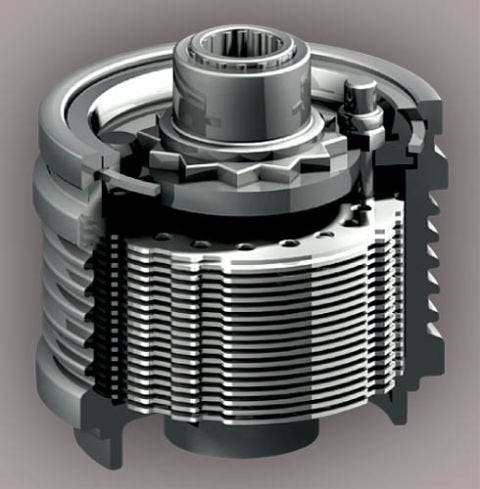
This is a differential with no gears. The input shaft from the transaxle (at the front wheels) and the output shaft to the rear wheels each carry a series of plates that are alternately intertwined and closely spaced. all the plates swim in a special fluid that transfers power from the input to the output plates when needed. If the front-drive wheels begin to slip, their shaft and plates spin more quickly than the others. This speed differential within the housing churns and heats the fluid, which thickens it and more tightly bonds the alternating plates. Some torque is at present sent to the grippier wheels until spinning ones regain traction.
Torsen Differential
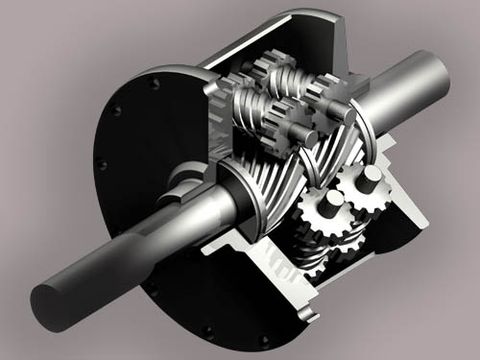
The Torsen dates dorsum to 1983. Since then it has been used by various carmakers, including Audi and Hummer. The Torsen multiplies what torque is available from the axle that is starting to spin or lose traction, and sends information technology to the slower-turning beam with meliorate traction. The gears allow a torque-bias ratio of four:i, which means they tin can deliver four times as much power to the nonslipping axle than can be supported by the slipping beam. One large reward of Torsen systems is that because they are purely mechanical, they react very speedily to slip.
Transfer Case
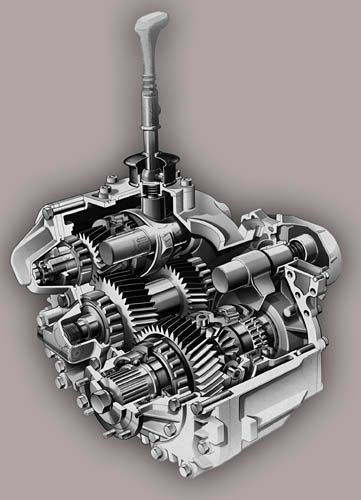
This is a dissever gearbox mounted behind the manual. Ability goes to the transfer case to be directed to the rear wheels only or to both front and rear. A separate driveshaft connects the transfer case to a differential in the front axle. Most transfer cases also offer ii gear ratios, for a High and Low range. While many vehicles still take a manually engaged transfer instance, several now offer electrically activated engagement.
This content is created and maintained by a tertiary party, and imported onto this page to aid users provide their email addresses. You may be able to find more than information well-nigh this and like content at piano.io
halliburtonseck1966.blogspot.com
Source: https://www.popularmechanics.com/cars/how-to/a250/1302716/
0 Response to "How Can I Tell What Transmission Is in a F150"
Publicar un comentario